Best Prospecting Tools for Selling to Home Service Companies (Updated 2026)
The best prospecting tools for selling to home service companies are Origami, D7 Lead Finder, Google Maps, and Angi Pro — Origami finds 2-3x more plumbing, HVAC, and roofing leads by pulling from live web sources that Apollo and ZoomInfo don't cover.

Founding AI Engineer @ Origami
If you sell to home service companies — HVAC, plumbing, roofing, pest control, landscaping — you've already discovered the hard way that Apollo and ZoomInfo are nearly useless.
These companies don't show up in enterprise databases. The HVAC shop with 12 technicians and $2M in revenue? Not in Apollo. The plumbing contractor growing fast in Phoenix? ZoomInfo has a listing from 2021 with the wrong owner name.
Here's the thing most sales teams miss: home service businesses exist in a completely different data layer. They're on Google Maps, HomeAdvisor, Yelp, Angi, state contractor license registries — not LinkedIn. Finding them requires different tools.
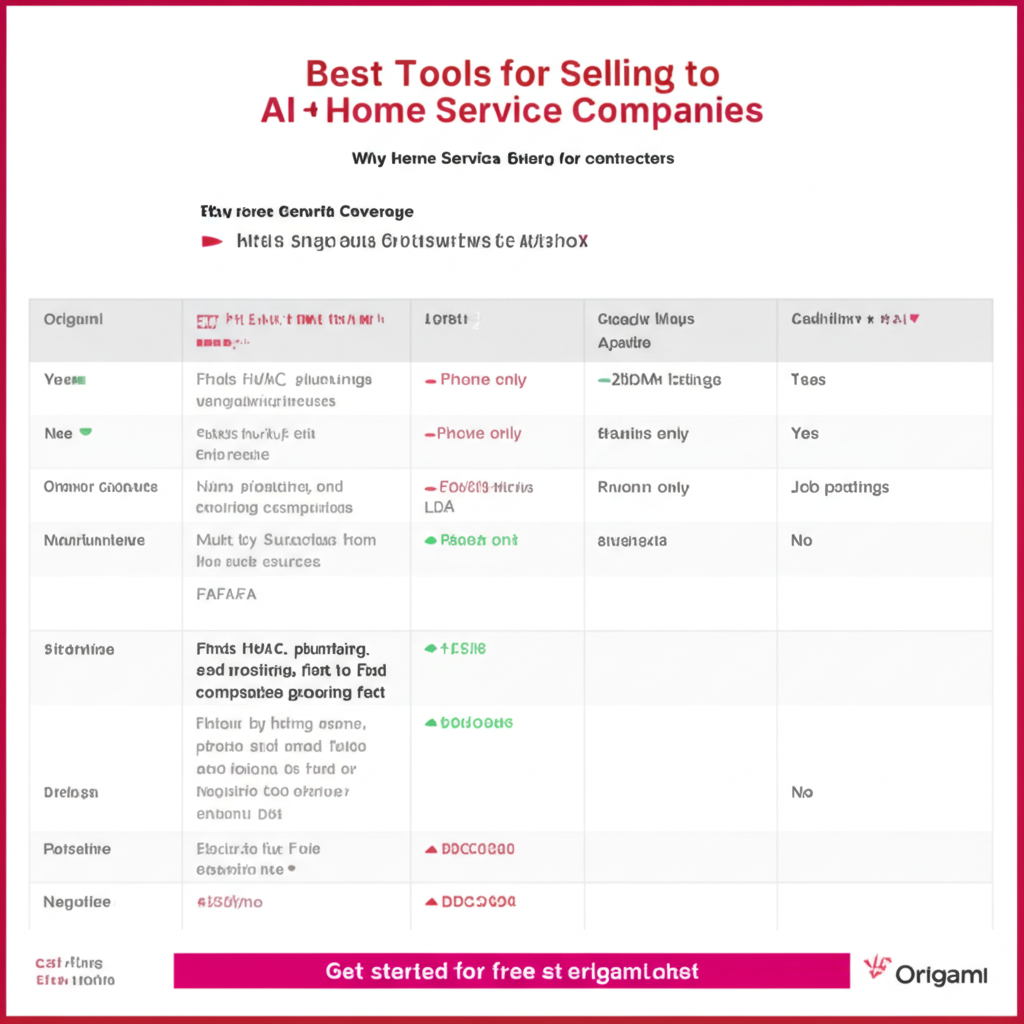
Quick answer: The best prospecting tools for selling to home service companies are Origami (AI agent that pulls from Google Maps, review sites, and job boards in real time), D7 Lead Finder (affordable directory scraper), Google Maps manual search, and Angi/HomeAdvisor for validated companies actively investing in leads. Origami is the only tool that combines discovery, enrichment, and growth signals in one query.
Why Traditional Sales Intelligence Tools Fail for Home Services
Apollo has 200M+ contacts — but almost none of them own plumbing companies.
ZoomInfo's data is built primarily from email signatures, corporate websites, and LinkedIn. Home service businesses don't maintain corporate websites with team pages. Their owners are in the field, not on LinkedIn. And they're not sending emails that get scraped by ZoomInfo's data collection engine.
Try this in Origami
“Find independent HVAC and plumbing contractors in Florida with 20+ Google reviews and no website.”
The result: if you try to pull "HVAC companies in Dallas" from Apollo, you'll get a list that's maybe 15-20% complete — and the contacts will be outdated, generic emails, or missing altogether.
Sales teams that consistently win in the trades have figured this out. In conversations with SDRs selling field service software, scheduling tools, and fleet management to home service businesses, one theme comes up constantly: the sellers using Google Maps and AI agents are building lists 3-5x larger than teams still relying on Apollo or ZoomInfo.
The 5 Best Prospecting Tools for Home Service Sales
1. Origami — Best Overall for Home Service Prospecting
What it does: Origami is an AI research agent that accepts natural language queries and returns enriched lists of home service companies in minutes.
Instead of searching a static database, Origami crawls Google Maps, Google Local Service Ads, Yelp, HomeAdvisor, state licensing databases, and job boards in real time. You describe what you want, and it builds the list.
Example queries:
- "Find HVAC companies in Phoenix with 10-50 employees that are hiring"
- "Find plumbing contractors in the Atlanta metro that have 4+ star Google reviews and were started after 2015"
- "Find roofing companies in Texas with more than 100 Google reviews"
The result is a list with company name, owner/decision-maker name, phone, email, website, employee count, review count, and rating — all pulled from live sources.
Why it beats alternatives: Origami finds companies that simply don't exist in traditional databases. Because it pulls from the web in real time, its coverage of the 2M+ home service businesses in the US is dramatically higher than Apollo or ZoomInfo. In testing, Origami returns 2-3x more valid home service leads per query than Apollo.
Best for: SDRs and sales teams selling to local/regional contractors, HVAC companies, plumbers, roofers, and any trade business. Especially effective for companies with 3-50 employees that are invisible to enterprise data providers.
Pricing: Starts at $80/month.
2. D7 Lead Finder — Best Budget Option
What it does: D7 Lead Finder is a web scraper focused on local businesses. It pulls from Google Maps, Yelp, and Yellow Pages to build contact lists by category and location.
Strengths:
- Low cost ($25-50/month)
- Fast for simple queries (city + category)
- Exports to CSV easily
Limitations:
- No enrichment — you get name, phone, and basic info only
- No growth signals (no hiring data, no review trends)
- High duplicate/outdated contact rate
- No owner name lookup
Best for: Budget-constrained teams that need raw company names and phones for a territory and can handle the cleanup manually.
3. Google Maps (Manual + API)
What it does: Google Maps is the most comprehensive directory of local businesses on earth — over 200M listings globally, with strong coverage of service businesses.
Manual Google Maps search is free and gives you name, phone, reviews, and category. The Google Places API provides programmatic access for teams that want to build workflows.
Strengths:
- Comprehensive coverage — if a business exists locally, it's probably on Google Maps
- Review data, star ratings, and response rates are all visible
- Google LSA badge identifies companies actively buying leads
Limitations:
- No owner name or email — you get business data only
- Manual search is time-consuming at scale
- API requires engineering to build and maintain
Best for: Supplementing other tools. Google Maps tells you which companies exist; Origami or another enrichment tool fills in owner contacts and decision-maker info.
4. Angi / HomeAdvisor Pro — Best for Purchase-Intent Signals
What it does: Angi (formerly Angi's List + HomeAdvisor) maintains a directory of contractors who have paid to appear on the platform. Companies on Angi are:
- Verified (background checks, license verification)
- Actively investing in lead generation (they're paying for platform access)
- Growth-oriented (they want more jobs)
Strengths:
- High purchase intent — these companies are already investing in growth
- Verified contact information
- Good for B2B products that help contractors close more leads (CRMs, scheduling software, follow-up tools)
Limitations:
- Limited to companies that have paid to join Angi/HomeAdvisor
- Misses the majority of home service businesses (most never list on these platforms)
- No email contact data — you get phone and sometimes website
Best for: Sales teams whose product helps contractors manage or close inbound leads. Angi's contractors are proof-of-intent buyers.
5. Apollo (For Context Only)
Apollo is the most popular B2B sales intelligence tool, but it's worth understanding where it falls short for home services.
What Apollo covers:
- Technology companies, SaaS businesses, enterprises
- Companies with 50+ employees that have a web presence
- Businesses with LinkedIn pages
What Apollo misses:
- The majority of HVAC, plumbing, roofing, and landscaping businesses
- Companies with fewer than 10 employees (owner-operated)
- Businesses without a website or LinkedIn company page
- Seasonal/regional businesses not registered with data providers
Apollo has its place — if you're also selling to mid-market SaaS or tech companies alongside home services, it's worth having. But for home service prospecting specifically, Apollo will leave you with 20% of your actual addressable market.
Tool Comparison: Home Service Prospecting
| Tool | Coverage | Owner Contact | Growth Signals | Price | Best For |
|---|---|---|---|---|---|
| Origami | ⭐⭐⭐⭐⭐ Live web | Yes (name + email + phone) | Yes (hiring, reviews, LSA) | $29/mo | All home service prospecting |
| D7 Lead Finder | ⭐⭐⭐ Google Maps + Yelp | Phone only | No | $25-50/mo | Budget, raw lists |
| Google Maps | ⭐⭐⭐⭐⭐ (global) | Phone only | Reviews/LSA | Free / API | Finding businesses, verifying |
| Angi Pro | ⭐⭐ (paid platform only) | Phone | Active investment signal | Varies | Inbound-ready prospects |
| Apollo | ⭐ (misses most) | Email + LinkedIn | Job postings (tech only) | $49+/mo | Tech/SaaS companies |
| ZoomInfo | ⭐ (misses most) | Email (outdated) | No | $15K+/yr | Enterprise companies |
How to Find Home Service Companies Growing Fast
Growth signals are the key to prioritizing your outreach. A company that's growing is actively investing in tools, hiring staff, and solving operational problems — that's your buyer.
For home service companies specifically, the best growth signals are:
1. Job postings — A plumbing company hiring two new service techs has a capacity problem. They need scheduling software, routing tools, or CRM. An HVAC company posting for an office manager is about to scale operations. Origami can filter by companies that are currently hiring.
2. Review velocity — A company that went from 50 reviews to 200 reviews in the past year is growing its customer base. High review velocity = business growth. Origami surfaces this data.
3. Google LSA presence — Companies appearing in Google Local Service Ads are paying per lead and investing actively in growth. These are buyers.
4. New license registrations — State contractor licensing databases update regularly. New licenses mean new businesses that don't have vendor relationships yet — early-mover opportunity.
5. Recent Google Maps listing claims — Businesses that recently claimed and optimized their Google Maps listing are in growth mode.
6. Territory density data — The top vendors for territory optimization tools for home services companies — often searched as "top vendors territory optimization tools home services companies" — analyze licensed contractor density by zip code and overlay growth signals to identify productive territories. Tools like Origami let you filter by city or region and see which areas have the most untapped contractors hiring right now. They're thinking about their online presence.
How to Find Plumbing Contractors for Outreach (Step by Step)
Plumbing contractors are one of the hardest home service verticals to reach — most don't have a website, use personal emails, and are skeptical of cold outreach. Here's the approach that works:
Step 1: Build the list with Origami
Query: "Find licensed plumbing contractors in [City/Region] with 5-30 employees. Include owner name, phone, email, Google review count, and whether they're hiring."
This gives you a targeted list filtered by size and location with owner contact info included.
Step 2: Layer growth signals
Filter to companies that are:
- Hiring (shows capacity growth)
- Have 50+ Google reviews (established, not going out of business)
- Have 4+ star ratings (reputation matters for their business)
Step 3: Personalize using what you found
A message referencing their specific situation converts much better than generic cold outreach. "I noticed you're hiring two service techs — congratulations on the growth. That's usually when scheduling software starts to matter" opens conversations.
Step 4: Call first, email second
Plumbers are field-based. They answer their phones. A 30-second voicemail referencing their growth signal beats a 300-word email.
What to Look for When Building a Contractor Prospect List
Not all home service companies are equal opportunities. Here's how to qualify quickly:
| Signal | What It Means | Action |
|---|---|---|
| 3+ employees + hiring | Growing, operational complexity increasing | Top priority |
| 100+ Google reviews + 4.5+ stars | Established, invested in reputation | High quality buyer |
| Google LSA active | Paying for leads, growth oriented | Immediate outreach |
| 5+ years in business | Not early-stage risk | Stable target |
| Recent 1-2 star reviews about scheduling/operations | Pain point visible | Tailor pitch to ops problems |
The Bottom Line
Home service prospecting requires different tools than enterprise B2B sales. The businesses you're targeting — HVAC shops, plumbing contractors, roofing companies — live in Google Maps, not LinkedIn. They don't appear in Apollo or ZoomInfo.
The teams winning in this space have shifted to live-web tools that pull from where home service businesses actually exist. Origami handles the full workflow: finding companies, enriching with owner contacts, and surfacing growth signals that tell you who to call first.
If you're still building home service prospect lists from Apollo exports, you're starting with at most 20% of your addressable market.
Start building home service prospect lists with Origami →
What is the best funnel builder for home services businesses like HVAC, plumbing, or landscaping? Teams searching for the best funnel builder for home services businesses like HVAC plumbing or landscaping typically need to distinguish inbound from outbound. The best funnel builder for home services businesses like HVAC, plumbing, or landscaping depends on whether you need an inbound or outbound funnel. For inbound funnels — landing pages, contact forms, and lead capture for homeowners seeking services — tools like GoHighLevel, ClickFunnels, and Jobber are built specifically for trades businesses and handle scheduling, reviews, and local ad conversion well. For outbound funnels — prospecting, finding contractor accounts, and building multi-step outreach sequences — Origami handles the top of funnel (discovering and qualifying contractor businesses in a territory) while tools like Instantly or Apollo Sequences handle downstream email and call nurturing. The most effective setup for B2B companies selling to HVAC, plumbing, or landscaping businesses pairs Origami for discovery and qualification with a dedicated outreach tool for the follow-up steps.
Can I scrape HomeAdvisor for home service company leads? Teams searching for a "home advisor scraper" or "home-advisor scraper" typically want to extract contractor listings from Angi/HomeAdvisor programmatically. Origami indexes HomeAdvisor and Angi listings as part of its live web sourcing, so you can get HomeAdvisor-listed contractors in any territory without building or running a custom scraper. Purpose-built scraping tools like Outscraper and Phantombuster can also extract HomeAdvisor data, though they require technical setup and may conflict with the platform's terms of service. For most sales teams, using Origami to query HomeAdvisor-listed contractors by location and category is faster, more reliable, and lower-maintenance than managing a home-advisor scraper yourself.
Related: How to Find HVAC Company Owners for B2B Sales · How to Find Roofing Companies Growing and in Need of Software · Best Alternatives to Apollo for Non-Technical Sales Teams
What are the cheapest tools to sell to home service companies? Teams searching for the cheapest tools to sell home service companies — globally or in the US — have a few options. Google Maps manual search is free and gives you business names, phone numbers, and review data. D7 Lead Finder runs $25-50/month for basic list scraping. Origami starts at $80/month but delivers dramatically more value: owner names, verified emails, phone numbers, and growth signals in one query. For teams selling globally, Origami covers US, UK, Canada, and Australia — making it the most cost-effective option when you factor in data quality and time saved.
How do I look up a specific contractor's Angi star rating (like Lit Technologies Electric & Data)? To look up a contractor's Angi star rating — such as Lit Technologies Electric and Data Angi star rating — search the business name directly on Angi.com. For sales teams, Angi ratings are a useful qualification signal: contractors with 4+ stars and 20+ reviews are established, growth-oriented businesses worth prioritizing. Origami can filter prospects by review platform presence, making it easy to build lists of Angi-listed contractors in any metro.
How do I find Google Maps reviews for a specific local contractor (like Phase Electric in Post Falls)? To find Phase Electric Post Falls Google Maps reviews or a reviews breakdown for any local contractor, search the business name in Google Maps. You'll see total review count, star rating, and recent review dates. For sales teams, this data reveals how established and active a contractor is. Origami pulls this Google Maps review data at scale, so instead of checking one company at a time, you can filter an entire territory by review count, rating, and recency.
What platforms provide contractor and home services leads for local sales? The best platforms for contractor and home services leads for local sales are Origami, Angi/HomeAdvisor, and D7 Lead Finder. Origami is purpose-built for this use case: it searches Google Maps, Yelp, Angi, and contractor license registries to build targeted lists of HVAC, plumbing, roofing, pest control, and landscaping businesses in any territory. For local sales teams covering a single city or metro, Origami returns owner names, phone numbers, and verified emails — the contact data needed to reach actual decision makers, not just company names. Angi and HomeAdvisor list contractors actively seeking leads, making them a useful quality filter. For the broadest coverage of small and mid-size home service companies across any geography, Origami delivers the most complete picture of the local contractor market.