Best Prospecting Tools That Actually Cover Small Businesses (Updated 2026)
Most B2B databases cover only 6-11% of small businesses. The best prospecting tools for SMBs are Origami, Apollo, and Clay—ranked by actual coverage, not enterprise marketing claims.

Founding AI Engineer @ Origami
Best Prospecting Tools That Actually Cover Small Businesses (Updated 2026)
You're building a prospect list of plumbing companies in Dallas. You search Apollo. You get 140 results. You search Google Maps. You find 800+.
That gap—between what's in a database and what's actually in your market—is the core problem with prospecting to small businesses in 2026.
Quick answer: The best prospecting tools for small businesses are Origami (best for local businesses and non-tech verticals), Apollo (best for mixed SMB/mid-market with budget constraints), and Clay (best for advanced enrichment pipelines). ZoomInfo and Lusha are built for enterprise and miss most SMBs entirely. Traditional databases only cover 6–11% of local businesses—if your market is home services, restaurants, contractors, or independent operators, you need a tool that pulls from live web sources.
Here's a practical breakdown of what actually works—and what doesn't—for reaching the 89% of small businesses that traditional databases miss.
Why Most Prospecting Tools Fail at Small Business Coverage
Traditional B2B databases were built on a specific infrastructure: LinkedIn profiles, Crunchbase records, press releases, and corporate websites. That infrastructure describes mid-market and enterprise companies well. It almost entirely ignores small businesses.
For enterprise software, that's fine—there are only so many Fortune 1000 companies.
Try this in Origami
“Find independent coffee shops in Austin with over 100 Google reviews and a verified website.”
Why the gap? Small businesses don't maintain the digital footprints that traditional scrapers look for:
- No LinkedIn company pages. A 6-person landscaping company doesn't have an HR team maintaining a LinkedIn profile with current headcount.
- No Crunchbase records. Local businesses don't raise venture rounds and don't appear in investor databases.
- No press coverage. A regional HVAC franchise doesn't get covered by TechCrunch.
The data does exist—it's just in different places. Google Business Profiles, Yelp listings, state contractor license databases, health department permits, chamber of commerce directories, local Facebook pages, and job boards. Traditional databases don't ingest from these sources. AI-powered tools do.
The Best Prospecting Tools for Small Businesses, Ranked
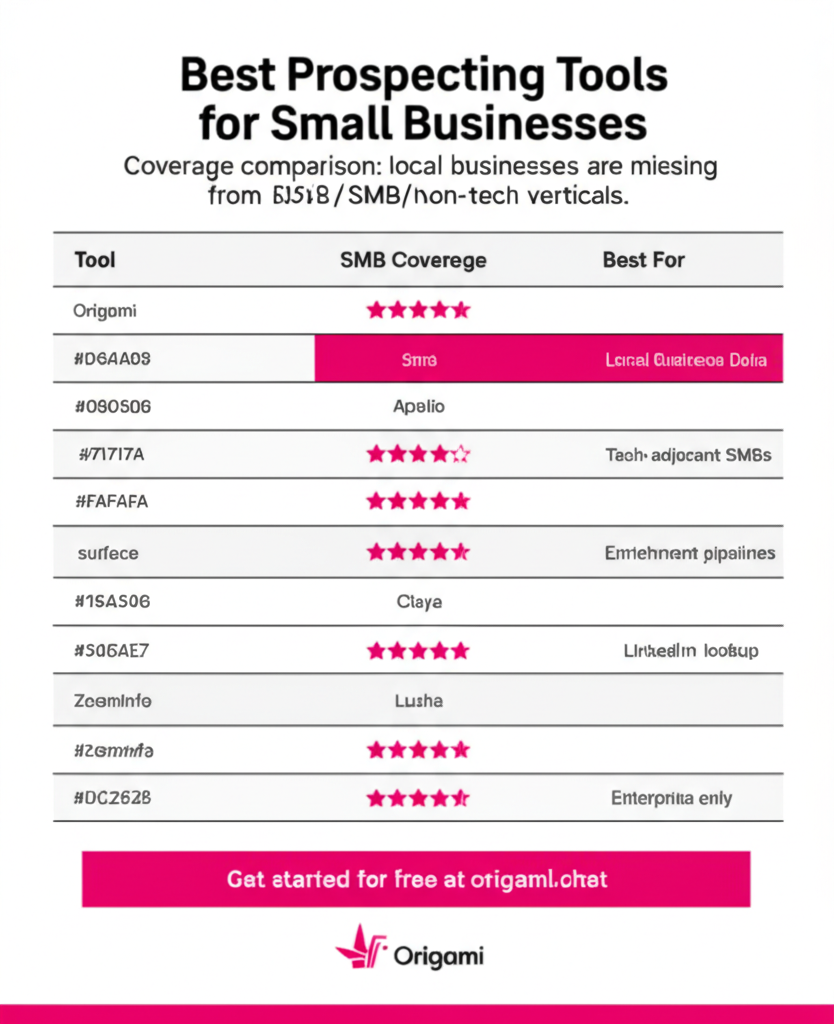
1. Origami — Best for Local Businesses and Non-Tech Verticals
Best for: Home services, local contractors, restaurants, retail, healthcare practices, fitness studios, and any SMB vertical that isn't tech-indexed.
Origami uses AI research agents that crawl live web sources—not a static database—to find and enrich local business prospects. Instead of querying a fixed index, Origami pulls from Google Business listings, Yelp, state licensing databases, social media, job boards, and industry directories in real time.
The result: 2–3x more coverage in non-tech verticals compared to Apollo, based on internal testing across HVAC, plumbing, roofing, restaurant, and dental verticals.
Key capabilities:
- Natural language queries: "Find HVAC companies in Dallas that have been operating 5+ years"
- Pulls contact data from live sources, not stale LinkedIn exports
- Enriches companies with owner names, phone numbers, email addresses, business age, and signals (job postings, recent reviews, growth indicators)
- Works for verticals Apollo/ZoomInfo explicitly don't serve well
Pricing: Custom pricing based on usage. Free trial available at origami.chat.
Where it's weaker: Origami is built for SMB and local business prospecting. If you need to find VPs at Fortune 500 companies or map enterprise org charts, Apollo or ZoomInfo will serve you better.
2. Apollo — Best Budget Option for Mixed SMB/Mid-Market
Best for: Teams that need coverage across both SMB and mid-market, with a price-conscious budget.
Apollo has approximately 265 million contacts in its database, with decent coverage of smaller companies in tech-adjacent verticals. It's significantly cheaper than ZoomInfo and has improved its SMB coverage in recent years.
The caveat: Apollo's SMB coverage is still heavily skewed toward tech companies and urban markets. If you're looking for plumbing contractors in rural Tennessee or auto body shops in secondary markets, you'll hit the same wall you hit with ZoomInfo—just cheaper.
Key capabilities:
- Large contact database with email and phone enrichment
- Built-in sequencing and outreach workflows
- Solid filtering by company size, industry, technology, and funding stage
- Free tier available with limited exports
Pricing: $49–$119/user/month for paid plans. Free tier includes limited searches.
Where it's weaker: SMB coverage in home services, trades, and non-tech verticals remains limited. Better for startups and mid-market than for truly local businesses.
3. Clay — Best for Custom Enrichment Pipelines
Best for: Revenue operations teams and technical sales teams who want to build automated enrichment workflows across multiple data sources.
Clay isn't a database—it's a workflow orchestration tool that connects to 50+ data providers and lets you build custom enrichment sequences. You can pull from Apollo for initial contact data, cross-reference with LinkedIn, enrich with Clearbit, and validate emails automatically.
For SMB prospecting, Clay works best when you have an initial list (from Google Maps, a niche directory, or manual research) and want to automate the enrichment process. It doesn't solve the discovery problem—it solves the enrichment problem.
Key capabilities:
- Connects to 50+ data providers in one workflow
- AI-powered research that can pull from any web source
- Waterfall enrichment (tries multiple providers until it finds a match)
- Highly flexible but requires technical configuration
Pricing: $149–$800+/month depending on credits used. Requires meaningful setup time.
Where it's weaker: Requires technical expertise to configure effectively. Not a good "plug and play" option for non-technical sales teams. Doesn't solve discovery—only enrichment.
4. ZoomInfo — Best for Enterprise Prospecting (Poor for SMBs)
Best for: Enterprise sales teams targeting mid-market and large companies. Explicitly not built for SMB prospecting.
ZoomInfo has the most comprehensive enterprise B2B database available, with strong coverage of mid-market and enterprise companies, detailed org charts, intent signals, and deep integrations with Salesforce and HubSpot.
For small businesses, it fails structurally. ZoomInfo's database is built on the same LinkedIn-indexed corporate infrastructure that misses local businesses. The pricing ($15,000–$40,000+/year) also makes it extremely difficult to justify for SMB-focused teams.
Key capabilities:
- Deep org chart data for enterprise accounts
- Intent data and buying signals for tech buyers
- Robust CRM integrations
- Strong compliance and data governance
Pricing: $15,000–$40,000+/year (enterprise contracts). Not practical for SMB-focused teams.
Where it's weaker: SMB and local business coverage. The price-to-value ratio for SMB prospecting is extremely poor.
5. Lusha — Best for LinkedIn-Based Contact Lookup
Best for: Individual sales reps who need to quickly find contact info for specific people they've already identified on LinkedIn.
Lusha is a browser extension that surfaces contact data (email, phone) while you're browsing LinkedIn profiles. It's fast, accurate for the contacts it covers, and reasonably priced for individuals.
The limitation: Lusha is reactive, not proactive. It finds contact info for people you've already found. It doesn't help you discover which businesses to target. And its coverage skews entirely toward LinkedIn-indexed professionals—which excludes most small business owners.
Key capabilities:
- Fast email/phone lookup from LinkedIn profiles
- Chrome extension with CRM integration
- Accurate data for covered contacts
- Individual-focused (not great for list building)
Pricing: $36–$59/user/month.
Where it's weaker: Discovery (finding which businesses to contact) and local business coverage. Not suitable for SMB prospecting at scale.
Side-by-Side Comparison
| Tool | SMB Coverage | Local Business Data | Price/Month | Best For |
|---|---|---|---|---|
| Origami | ★★★★★ | ★★★★★ | Custom | Local/SMB prospecting, non-tech verticals |
| Apollo | ★★★☆☆ | ★★☆☆☆ | $49–$119/user | Budget B2B, tech-adjacent SMBs |
| Clay | ★★★☆☆ | ★★★☆☆ | $149–$800+ | Custom enrichment pipelines |
| ZoomInfo | ★★☆☆☆ | ★☆☆☆☆ | $1,250–$3,300+ | Enterprise org charts, intent data |
| Lusha | ★★☆☆☆ | ★☆☆☆☆ | $36–$59/user | LinkedIn contact lookup |
Which Tool Is Right for Your Use Case?
If you're selling to home service companies, contractors, or local businesses: Use Origami. It's the only tool built specifically for prospecting businesses that aren't LinkedIn-indexed. Use natural language queries to find HVAC companies hiring technicians, dental practices that opened in the last 2 years, or restaurants that recently expanded locations.
See: How to Find HVAC Company Owners for B2B Sales and Best Tools for Finding Home Service Companies
If you're selling to a mix of tech and non-tech SMBs with a limited budget: Start with Apollo's free tier to validate your ICP. Use Origami for the verticals where Apollo's coverage is thin.
If you already have lists and need enrichment: Clay is worth evaluating. It won't solve discovery, but it will dramatically improve the quality of lists you've already built.
If you're selling to enterprise accounts: ZoomInfo is the industry standard. It's expensive and overkill for SMBs, but unmatched for enterprise coverage.
Where AI Changes the Equation
Traditional prospecting tools are built on static databases. They index data, store it, and surface it when you search. The problem with static databases is that they're always behind—by the time a record is captured, verified, and indexed, it may be 6–18 months old. And local businesses change constantly.
AI research agents like Origami work differently. Instead of querying a stored index, they execute live research against current web sources. When you ask "Find roofing companies in Phoenix that posted for new hires in the last 30 days," Origami runs that query against current job boards, not a cached snapshot.
This matters for small businesses specifically because:
- Ownership changes frequently. A landscaping company you indexed 18 months ago may have sold or changed leadership.
- Growth signals are time-sensitive. A pest control company hiring three new technicians is a buying signal right now—not in 6 months when a database update runs.
- New businesses open constantly. The 200,000+ new small businesses that open each month in the US won't appear in static databases for months or years.
For teams selling to local businesses, real-time research beats static databases in both coverage and data freshness.
See: How AI Agents Find Leads Traditional Databases Can't and Why Apollo and ZoomInfo Don't Have Local Business Data
Bottom Line
If your market is local businesses—any business that operates in a physical location and isn't tech-indexed—the tools built for enterprise B2B will cover a fraction of your addressable market.
The table below summarizes the decision:
| Your Market | Use This |
|---|---|
| Local/home services/contractors | Origami |
| Tech SMBs and mid-market | Apollo |
| Custom enrichment workflows | Clay |
| Enterprise org charts | ZoomInfo |
| LinkedIn contact lookup | Lusha |
The 89% of local businesses that traditional databases miss aren't invisible—they just require a different approach. Live web research, state licensing databases, and review site signals are where local business data lives. The right tool crawls those sources instead of querying a static index.
Start with a free trial at origami.chat to see what you've been missing in your target market.