How to Find Independent Pharmacy Owners for B2B Outreach (2026)
Independent pharmacy owners are invisible in Apollo and ZoomInfo. Heres where community pharmacy and compounding pharmacy data actually lives—and how to reach independent pharmacists who make buying decisions.

Founding AI Engineer @ Origami
How to Find Independent Pharmacy Owners for B2B Outreach (2026)
There are approximately 21,000 independent pharmacies in the United States—community pharmacies, compounding pharmacies, specialty pharmacies, and long-term care pharmacies run by owner-pharmacists. If you sell pharmacy software, compliance tools, insurance, PBM services, marketing, or any product serving the pharmacy industry, this market is enormous.
Quick answer: To find independent pharmacy owners, search state pharmacy board license databases by pharmacy type, check the NCPA (National Community Pharmacists Association) member directory, look for compounding pharmacies through PCAB accreditation lists, monitor job postings for pharmacies that are hiring, and use an AI prospecting tool like Origami that pulls owner-level contact info from live data sources. Apollo and ZoomInfo return almost no results for independent pharmacy owners because these businesses are not LinkedIn-indexed.
Pull up Apollo and search "independent pharmacy" or "community pharmacy owner." You'll get a handful of results—mostly pharmacy benefit managers, pharmacy chains, and corporate healthcare entities. The 21,000 independent owners? Gone.
Why Apollo and ZoomInfo Don't Find Independent Pharmacists
Independent pharmacy owners are healthcare professionals first and business owners second. Most pharmacist-owners focus on their clinical work and patient relationships. They're not maintaining detailed LinkedIn profiles, and their community pharmacies don't have robust LinkedIn company pages.
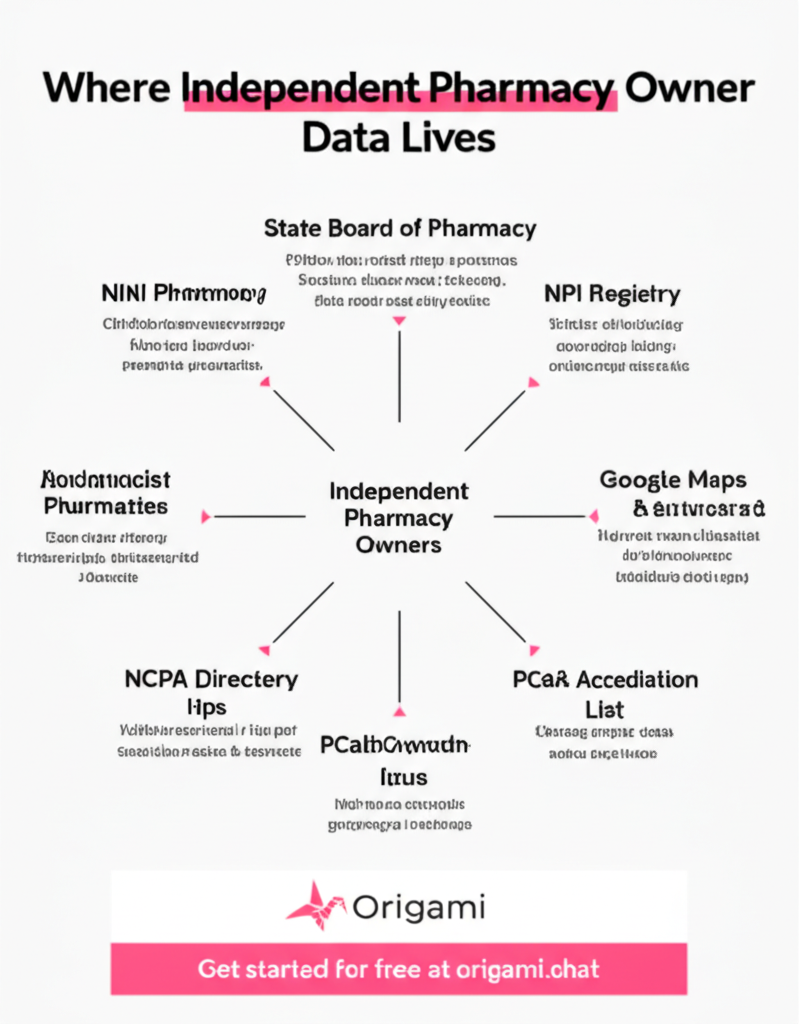
Their professional presence lives in state pharmacy board registries, professional association directories (NCPA, APhA), NPI (National Provider Identifier) databases, Google Business Profiles, and healthcare-specific directories. Traditional B2B databases don't pull from any of these.
The Three Types of Independent Pharmacy Owners You're Missing
Community pharmacy owners: The traditional neighborhood pharmacy. Owner is typically a licensed pharmacist (RPh or PharmD) who owns and operates one or two locations. These are the businesses most B2B sellers completely miss—they're not in databases, but they're buying pharmacy management software, POS systems, compliance tools, and delivery services constantly.
Compounding pharmacy owners: Pharmacies that prepare customized medications for individual patients. These are higher-revenue, more complex businesses that need specialized equipment, supplies, and compliance tools. PCAB (Pharmacy Compounding Accreditation Board) accreditation is a public record that surfaces these businesses directly.
Try this in Origami
“Find independent pharmacy owners in the Northeast who mention medication synchronization on their websites.”
Specialty pharmacy owners: Pharmacies focused on complex medications (oncology, HIV, infertility, rare diseases). They're smaller in number but have significantly higher revenue and specific software, compliance, and logistics needs. URAC and ACHC accreditation databases are public sources for these businesses.
21,000 independent pharmacies. Apollo finds maybe 200—mostly pharmacy chains and PBM entities that already have massive enterprise vendor relationships. The 20,800 independent owners are invisible.
Where Independent Pharmacy Data Actually Lives
Independent pharmacy owners are highly regulated. That regulation creates a rich, publicly accessible data trail.
1. State Board of Pharmacy License Registries
Every pharmacy in the US must be licensed by the state board of pharmacy. Most state boards publish searchable, public-facing registries of licensed pharmacies. These registries include:
- Pharmacy name and address
- Pharmacist-in-charge (PIC) name—often the owner
- License number and status
- License issue and expiration dates
- Pharmacy type (retail, compounding, specialty, mail-order)
Filtering by pharmacy type lets you isolate compounding pharmacies, independent retail pharmacies, or specialty dispensaries specifically. This is the single best source for comprehensive pharmacy owner data and it's entirely public.
2. NPI (National Provider Identifier) Database
Every licensed pharmacy and pharmacist has an NPI—a unique identifier required for all healthcare billing. The NPPES (National Plan and Provider Enumeration System) database is public and searchable at npiregistry.cms.hhs.gov. You can search by:
- Taxonomy code (independent pharmacy, compounding pharmacy)
- State or zip code
- Business name or individual name
NPI records include the business address, primary contact, and often the owner's name as the authorized official. This covers independent pharmacies across all 50 states.
3. NCPA Member Directory
The National Community Pharmacists Association (NCPA) represents 19,000+ independent community pharmacies. Their member directory is accessible and lists pharmacies by state and specialty. NCPA members are engaged, association-active pharmacy owners—a high-quality filter for community pharmacy decision-makers.
4. PCAB Accreditation List (Compounding Pharmacies)
The Pharmacy Compounding Accreditation Board (PCAB) publishes a public list of all PCAB-accredited compounding pharmacies. These are verified, quality-certified compounding operations—a defined, searchable segment with specific needs for equipment, supplies, and compliance tools.
5. Google Business Profiles
Despite being regulated healthcare businesses, independent pharmacies maintain Google Business Profiles because patients search for them this way. A search for "independent pharmacy [city]" or "compounding pharmacy [city]" returns local listings with phone numbers, websites, and review data.
6. Healthgrades and Vitals
Healthcare directories like Healthgrades and Vitals list pharmacy locations, types, and often the pharmacist-in-charge by name. These databases are updated regularly and offer geographic filtering.
7. Job Postings
Independent pharmacies posting for pharmacists, pharmacy technicians, or front-end staff are growing or replacing staff—both are signals. A pharmacy adding a second pharmacist is expanding its capacity. A pharmacy hiring a technician is adding volume.
How to Find Pharmacy Owners Manually
Manual research for pharmacies is actually more structured than most local business verticals—because regulation creates public records. But it's still slow at scale.
Step 1: State Board of Pharmacy Search
Go to your target state's Board of Pharmacy website. Most offer searchable license databases. Filter for "pharmacy" license type and your target geography.
Export what you can (pharmacy name, address, pharmacist-in-charge name). Some states allow bulk exports. Others require manual record-by-record research.
Time: 2-4 hours per state depending on the database interface Owner name: Often surfaced directly as "Pharmacist in Charge" or "Owner"
Step 2: NPI Registry Cross-Reference
Use the CMS NPI registry to fill gaps and get additional contact info. Search by state and pharmacy taxonomy code. Export results to cross-reference against your board of pharmacy list.
Time: 1-2 hours per state Data quality: Addresses current as of last NPI update (varies)
Step 3: Owner Email Research
State board records give you names and business addresses. Getting email addresses still requires:
- Checking the pharmacy website for a "Contact" page
- Searching the owner's name on LinkedIn
- Checking NCPA or state pharmacy association directories for member emails
- Calling the pharmacy to ask for the owner's email directly
Realistic throughput: 5-8 enriched pharmacy owner records per hour
For 500 pharmacies across 5 states, you're looking at 60-100 hours of manual research.
How to Find Independent Pharmacy Owners at Scale with AI
AI prospecting tools eliminate the cross-referencing and enrichment bottleneck.
The Origami Workflow for Pharmacy Prospecting
Describe your ICP in plain language:
- "Find independent pharmacy owners in Texas with compounding accreditation"
- "Find community pharmacies in the Southeast that are NCPA members"
- "Find pharmacy owners in California with 50+ Google reviews"
- "Find independent pharmacies in Ohio that are hiring pharmacy technicians"
- "Find specialty pharmacies in the Midwest that are URAC accredited"
The agent pulls from state board registries, NPI databases, NCPA directories, accreditation lists, Google Maps, and job boards—returning an enriched list with owner names, contact info, license details, and buying signals.
Comparison: Manual vs. AI-Assisted Pharmacy Prospecting
| Method | Time for 500 Pharmacies | Owner Email Rate | Compliance Data |
|---|---|---|---|
| Manual (state board + NPI + enrichment) | 60-100 hours | ~25% | Partial |
| NCPA directory only | 5-10 hours | ~20% | None |
| AI Agent (Origami) | 20-30 minutes | ~65% | Yes (license status, accreditations, NPI) |
Infographic: Independent Pharmacy Owner Data Sources
Buying Signals That Make a Pharmacy Owner a Hot Prospect
Independent pharmacies have specific, predictable buying cycles driven by regulatory requirements, software contracts, and business lifecycle events.
License renewal approaching: State pharmacy licenses renew annually or biennially. Pharmacies renewing soon are reviewing their operational setup—often a window for compliance tools, liability insurance, and software upgrades.
Hiring a second pharmacist: A pharmacy adding a second full-time pharmacist is doubling its capacity. They need scheduling software, prescription volume management tools, and potentially expanded POS and workflow systems.
Opening a second location: A pharmacy owner opening a location #2 needs everything duplicated—software licensing, insurance, equipment, marketing. This is a high-value moment to be in front of them.
New compounding accreditation (PCAB): A pharmacy recently achieving PCAB accreditation has just invested heavily in equipment, training, and process. They're actively buying compounding supplies, specialized software, and quality management tools.
Recent reviews mentioning specific pain points: "Long wait times," "hard to reach," or "delivery issues" in Google reviews signal operational bottlenecks—windows for scheduling, delivery, and patient communication tools.
A pharmacy opening a second location or achieving new accreditation is spending heavily and receptive to new vendor relationships. These events are your entry window.
Outreach That Works for Independent Pharmacy Owners
Pharmacist-owners are clinically trained and evidence-oriented. They're skeptical of vendor claims and respond to specific, relevant value propositions—not generic pitches.
What Independent Pharmacy Owners Actually Care About
- PBM (Pharmacy Benefit Manager) reimbursements: DIR fees and low reimbursement rates are the #1 existential concern for most independent pharmacies. Anything that helps navigate or improve PBM relationships is immediately relevant.
- Prescription volume and patient retention: Keeping patients coming back vs. losing them to CVS or Walgreens is a constant challenge. Marketing, loyalty programs, and patient communication tools address this directly.
- Compliance and regulatory burden: HIPAA, DEA requirements for controlled substances, state board compliance, accreditation maintenance. Compliance tools are an easy sale if framed around reducing administrative time.
- Compounding-specific needs: Custom formulation software, USP <795> and <797> compliance, quality management systems, specialized supplies.
- 340B program management: Pharmacies participating in 340B need specific software and compliance tracking. This is a narrow but valuable segment.
Sample Outreach Email
Subject: Independent pharmacy tools for [City]

Dr./[Owner name],

I work with independent pharmacies in [state] and wanted to reach out—[Company Name] keeps coming up as a well-run operation in [city].

We help community pharmacies like yours [specific value prop—reduce DIR fee impact / improve patient adherence / streamline compounding compliance].

Not trying to add to your plate—happy to share how it works in a 15-minute call. Worth connecting?

[Your name]
Note: Address pharmacist-owners as "Dr." (PharmDs) or formally by last name. Using their academic title signals that you understand the industry.
Best Outreach Timing
- Email: Early morning (before the pharmacy opens, 7-8 AM) or evening
- Phone: 8-9 AM before the first patients arrive or after 6 PM
- Avoid: 10 AM-2 PM (peak prescription filling hours) and Monday mornings (post-weekend prescription backlog)
Tools for Finding Independent Pharmacy Owners
- Origami — AI agent for independent pharmacy prospecting. Pulls from state board registries, NPI databases, NCPA directories, accreditation lists, and job boards. Free to start (1,000 credits, no card required).
- State Boards of Pharmacy — Public license registries for every licensed pharmacy by state. Start at nabp.pharmacy for links to all state boards.
- CMS NPI Registry — npiregistry.cms.hhs.gov. Search by state and pharmacy taxonomy code for any licensed pharmacy or pharmacist.
- NCPA Member Directory — National Community Pharmacists Association lists 19,000+ independent pharmacy members.
- PCAB Accreditation Database — Full list of PCAB-accredited compounding pharmacies. Public and searchable.
- Healthgrades — Lists pharmacies by location with pharmacist-in-charge names.
- Indeed/ZipRecruiter — Monitor pharmacies posting jobs for growth signals.
Start Finding Independent Pharmacy Owners Today
21,000 independent pharmacies. Traditional databases find fewer than 1% of them.
The data exists—in state board registries, NPI databases, NCPA directories, PCAB accreditation lists, and job boards. It just isn't in the databases most sales teams use.
Manually cross-referencing state boards, NPI records, and directories takes 60-100 hours to cover 500 pharmacies. An AI agent does it in 20 minutes—with owner names, contact info, license status, and accreditation details included.
Try Origami free at origami.chat — 1,000 credits, no credit card required. Describe your target pharmacy profile (independent, compounding, specialty, geographic focus) and see what comes back.