How to Find Cleaning Company Owners by City for B2B Sales (2026)
Cleaning company owners dont show up in Apollo or ZoomInfo. Heres where commercial and residential cleaning business data actually lives—and how to build enriched prospect lists in minutes.

Founding AI Engineer @ Origami
How to Find Cleaning Company Owners by City for B2B Sales (2026)
There are over 1 million cleaning businesses in the United States—residential maids, commercial janitorial crews, post-construction cleanup services, and everything in between. If you sell software, insurance, equipment, supplies, or services to this industry, it's one of the largest underserved B2B markets in the country.
Quick answer: To find cleaning company owners by city, search Google Maps and Yelp for cleaning services in your target area, cross-reference with state business license databases, monitor job postings for companies that are hiring, and use AI prospecting tools like Origami that pull from live web sources.
Open Apollo and search "cleaning company owner." You'll get a handful of results—mostly corporate facility management firms and large franchise brands. The 900,000+ independent cleaning businesses? Not there.
Why Apollo and ZoomInfo Don't Find Cleaning Company Owners
Traditional B2B databases are built on LinkedIn-indexed data. The owner of a local residential cleaning service or a 10-person commercial janitorial company isn't maintaining a LinkedIn profile tagged "Owner, [City] Cleaning Co."
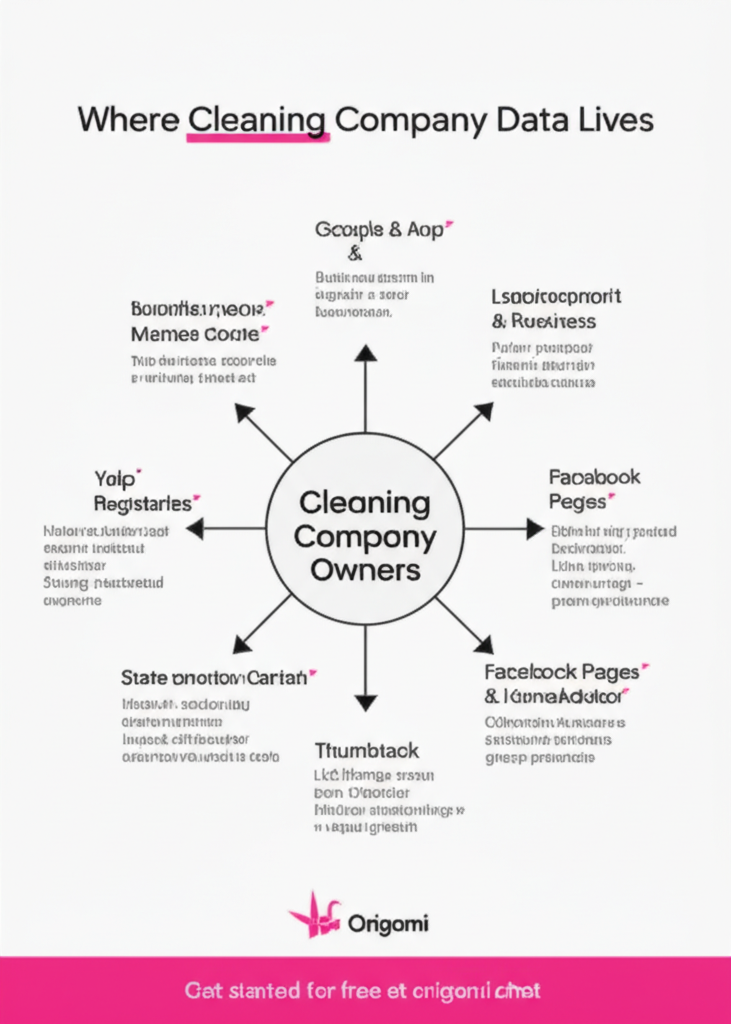
Cleaning businesses are hyperlocal. Their digital presence lives on Google Business Profiles, Yelp listings, Angi, Thumbtack, and local Facebook groups. These are the sources where cleaning company data actually lives—and they're not what traditional databases monitor.
What Traditional Databases Miss
Independent residential cleaning services: Single owner-operators and small teams running house cleaning routes in a specific city or neighborhood. They have Google reviews and a Facebook page. No LinkedIn company page.
Commercial janitorial companies: Small-to-midsize operations cleaning offices, retail spaces, and commercial buildings. Many are family-run businesses with 5-30 employees. Invisible to Apollo.
Specialty cleaning services: Post-construction cleanup, move-in/move-out services, crime scene cleanup, power washing, carpet cleaning. These are established businesses with recurring commercial contracts—but they're not indexed in any traditional B2B database.
Franchise operators: Many cleaning franchisees (Merry Maids, Jan-Pro, ServiceMaster) are owner-operators running a single or multi-unit franchise. Their contact info doesn't surface in standard database searches.
Over 1 million cleaning businesses in the US. Traditional databases cover fewer than 2%—mostly large corporate accounts that already have enterprise vendors.
Where Cleaning Company Owner Data Actually Lives
Cleaning business owners leave rich digital footprints. Just not in the places most sales teams look.
1. Google Business Profiles and Maps
Every active cleaning company has a Google Business Profile. A search for "house cleaning services [city]" or "commercial janitorial [city]" returns dozens to hundreds of results with business names, addresses, phone numbers, and website URLs.
Review counts tell you a lot: 50+ reviews with high ratings signals an established, active business with a real client base. New listings with 5-10 reviews signal a recently launched service—an opportunity if you're selling business formation, insurance, or early-stage tools.
2. Yelp and Angi (Formerly Angie's List)
Yelp has exceptional coverage of cleaning businesses, particularly residential services. Many cleaning business owners actively respond to reviews—and those responses often include their name, giving you a direct contact.
Angi is the largest home services marketplace in the US. Contractors pay to appear in Angi listings, which means businesses listed there are active, paying for leads, and interested in growing. These are warmer prospects than cold database pulls.
3. State Business License and LLC Registries
Most states require cleaning companies to register as an LLC or sole proprietorship. Secretary of State databases are public and searchable by business type or keyword. Filter for businesses registered in the last 12 months to find companies in early growth mode—they're actively investing in tools and services.
This is especially powerful for commercial cleaning companies because they often register under the county where they operate, which makes geographic filtering precise.
4. Thumbtack and HomeAdvisor Listings
Thumbtack and HomeAdvisor are lead generation platforms for home service businesses. A cleaning company actively paying for Thumbtack Pro or HomeAdvisor leads is actively growing its client base and more open to tools that help them scale.
Listings include business names, service areas, and often owner names and contact info.
5. Job Postings
A cleaning company posting jobs on Indeed, ZipRecruiter, or Craigslist for cleaners, supervisors, or account managers is scaling. Job postings surface growing businesses before any other signal—they've already decided to expand, which means they're actively spending money.
What to look for: Job titles like "Commercial Cleaning Technician," "Residential House Cleaner," "Cleaning Crew Lead," "Account Manager – Janitorial," or "Operations Manager – Cleaning Services."
6. Facebook Groups and Business Pages
Local cleaning company owners are active in community Facebook groups and business owner groups. Facebook Business Pages for cleaning services often include owner names, phone numbers, and direct messaging.
Search Facebook for "[city] cleaning services" and filter by Pages—you'll find active, local businesses not indexed anywhere else.
7. Nextdoor and Community Referral Boards
Residential cleaning services are one of the most recommended categories on Nextdoor. Business owners who show up in neighborhood recommendations are active, well-reviewed, and building their customer base. Nextdoor doesn't offer a business directory export, but it's useful for identifying specific businesses to research.
How to Find Cleaning Company Owners Manually
You can build a cleaning company prospect list without any paid tools. Here's what the manual process looks like—and where it breaks down.
Step 1: Google Maps Grid Search
Search "house cleaning [city]" or "commercial janitorial [city]" and scroll through every result. Export names, phone numbers, and website URLs to a spreadsheet.
Problem: Google Maps shows approximately 20 results per search. For full city coverage, you need to search by neighborhood, district, or zip code and combine results. A 10-zip-code city might require 10-20 separate searches.
Time: 2-3 hours per city for basic business info Owner name and email: Requires visiting every website individually
Step 2: Yelp and Angi Search
Repeat the same grid search on Yelp and Angi to find businesses not on Google Maps (or to get additional contact info). Yelp listings sometimes include owner names in review responses.
Time: 1-2 hours additional per city New businesses found vs. Google: Typically 20-30% new finds
Step 3: Owner Research Per Business
For each company found, dig up the owner's name and email:
- Check the website "About" or "Meet the Team" page
- Look for owner signatures in Google review responses
- Search the company name on LinkedIn
- Check Facebook Business page (sometimes shows admin names)
Realistic throughput: 4-6 enriched owner records per hour
For 300 cleaning businesses across 3 cities, you're looking at 50-75 hours of manual research before any outreach begins.
Manual prospecting works fine for 20 companies. It completely collapses at 200.
How to Find Cleaning Company Owners at Scale with AI
AI prospecting agents like Origami automate the entire discovery and enrichment process—across all these sources simultaneously.
The Origami Workflow for Cleaning Company Prospecting
Instead of running 10 separate Google Maps searches and visiting 300 websites, you describe your target in plain language:
- "Find residential cleaning company owners in Atlanta with 50+ Google reviews"
- "Find commercial janitorial companies in Chicago that are hiring"
- "Find cleaning businesses in Texas that have been operating for 2+ years"
- "Find cleaning company owners in Phoenix who listed on Angi or Thumbtack"
- "Find Merry Maids and Jan-Pro franchisees in the Southeast"
The agent searches Google Maps, review platforms, job boards, state registries, and franchise directories—then returns an enriched list with owner names, contact info, and buying signals.
What the Output Looks Like
For each cleaning company, you get:
- Business name, type (residential/commercial/specialty), and location
- Owner or operator name
- Contact info (email, phone)
- Employee count estimate
- Buying signals (hiring, new location, franchise activity, recent launch)
- Fit score (0-100) based on your criteria
Time and Quality Comparison
| Method | Time for 300 Companies | Owner Email Rate | Signals Included |
|---|---|---|---|
| Manual (Maps + website research) | 50-75 hours | ~30% | None |
| Yelp/Angi research only | 15-20 hours | ~15% | None |
| AI Agent (Origami) | 15-20 minutes | ~70% | Yes (hiring, growth, new launch) |
Best Infographic: Where Cleaning Company Data Lives
Buying Signals That Indicate a Hot Cleaning Prospect
Finding cleaning companies is one thing. Finding the ones most likely to buy is another. These signals separate active buyers from cold contacts.
Hiring activity: A cleaning company posting 3+ jobs simultaneously is scaling fast. They need scheduling software, route optimization, payroll tools, and HR compliance resources.
New business registration: A cleaning LLC registered in the last 6 months is actively building its business and needs insurance, software, supplies, and services. Early-stage businesses are often underserved and ready to invest.
High Yelp/Google review volume: 100+ reviews with a 4.5+ rating signals a healthy, growing business with real revenue. This is a better signal than business age alone.
Active on Thumbtack/Angi: Companies actively paying for lead generation are in growth mode. If they're willing to pay for leads, they're willing to pay for tools that help them convert those leads.
Multiple service lines: A cleaning company that offers both residential and commercial, or that has added specialty services like post-construction or biohazard, is expanding its market. These businesses are more sophisticated buyers.
Three or more of these signals together means you're looking at a serious operator—not a side hustle.
Outreach That Actually Works for Cleaning Business Owners
Cleaning company owners are working people. They're running crews, doing quality checks, handling client calls, and managing scheduling. Your outreach has to earn attention fast.
What Cleaning Business Owners Care About
- Scheduling and route optimization — Managing crews across multiple jobs is complex and error-prone
- Payment collection — Late payments from residential clients and slow commercial net-terms are constant pain points
- Insurance and liability — Workers' comp, general liability, and bonding are expensive and confusing
- Customer acquisition — Getting new residential clients and landing commercial contracts
- Employee retention — High turnover is a constant in cleaning businesses
Lead with the specific pain point most relevant to what you sell.
Sample Outreach Email
Subject: Saw you're hiring cleaners in [city]

[Owner name],

Congrats on the growth — I saw you're adding cleaning staff at [Company Name].

Most cleaning companies scaling like this hit the same bottleneck: managing crew schedules, tracking jobs, and collecting payments becomes a nightmare in spreadsheets.

We work with cleaning businesses in [city] to fix this. Worth a quick call?

[Your name]
Best Outreach Timing
- Email: Early morning (7–8 AM before crews dispatch) or evening (after 6 PM)
- Phone: 7–8 AM is when many cleaning business owners are coordinating crew assignments
- Avoid: Midday (owners are often doing quality checks on job sites)
Tools for Finding Cleaning Company Owners
- Origami — AI agent for automating cleaning company prospecting. Searches Google Maps, Yelp, Angi, Thumbtack, job boards, and state registries. Free to start (1,000 credits, no credit card required).
- Google Maps — Best starting point for manual research by city and neighborhood.
- Yelp — Strong coverage of residential cleaning services. Owner names sometimes in review responses.
- Angi/HomeAdvisor — Lists active businesses paying for leads—high-quality signal.
- Thumbtack — Particularly strong for small residential cleaning operations.
- State SOS databases — Public business registration records for new company identification.
- Indeed/ZipRecruiter — Monitor for cleaning companies posting jobs (growth signal).
Start Finding Cleaning Company Owners Today
Over 1 million cleaning businesses. Traditional databases find fewer than 2% of them.
The rest live in Google Maps, Yelp, Angi, Thumbtack, job boards, and state business registries—sources AI agents can monitor automatically.
You can spend 50+ hours building a list of 300 cleaning company owners manually, or spend 20 minutes with an AI agent and get the same list enriched with contact info, buying signals, and fit scores.
Try Origami free at origami.chat — 1,000 credits, no credit card required. Describe your target cleaning company profile and see what comes back in minutes.