How to Find Auto Body Shop Owners by Location for B2B Sales (2026)
Auto body shop owners are invisible in Apollo and ZoomInfo. Heres where collision repair and auto body shop data actually lives—and how to build enriched prospect lists by city or state.

Founding AI Engineer @ Origami
How to Find Auto Body Shop Owners by Location for B2B Sales (2026)
There are roughly 40,000 auto body shops in the United States—collision repair centers, custom paint shops, paintless dent repair specialists, and everything in between. If you sell software, equipment, insurance, supplies, or financing to the automotive aftermarket, this is an enormous market with almost no competition from modern sales teams.
Quick answer: To find auto body shop owners by location, search Google Maps for "auto body shop" and "collision repair" in your target city, cross-reference with state DMV or auto repair facility registries, check industry directories like CARSTAR and I-CAR, monitor job postings for shops that are hiring technicians, and use an AI prospecting tool like Origami that pulls from live local web sources rather than LinkedIn-indexed databases.
Search Apollo for "auto body shop owner" or "collision repair." You'll get a small collection of corporate collision center chains and dealership-owned body shops. The 38,000+ independent owner-operated shops? Completely absent.
Why Apollo and ZoomInfo Miss Auto Body Shop Owners
Auto body shop owners are tradespeople-turned-entrepreneurs. They spent years as body technicians, then opened their own shops. They're not maintaining LinkedIn profiles with "Owner, [City] Auto Body" as their job title, and their businesses don't have LinkedIn company pages with populated headcounts.
Their digital presence lives in Google Maps, Yelp, CarFax reviews, CARSTAR directories, local Facebook business pages, and state motor vehicle repair facility registrations. Traditional B2B databases don't monitor any of these sources.
What the Gap Looks Like
Independent collision shops: Single-location repair shops owned by a technician or family. They have Google reviews, a website, and sometimes Yelp listings. No LinkedIn data whatsoever.
Multi-location independents: An owner who built from one shop to three or four locations over 20 years. These are real businesses with significant revenue—and they're completely dark in traditional databases.
Specialty auto body shops: Classic car restoration, custom paint, mobile paintless dent repair, fleet repair contractors. Each is a distinct business type with its own directory presence—none of which are sources Apollo monitors.
Insurance-preferred shops (DRP shops): Shops on insurer Direct Repair Programs (State Farm Select Service, GEICO Auto Repair Xpress, Allstate Good Hands Repair Network) are vetted, high-volume, and financially stable. Their contact info is available in insurer directories—but again, not in LinkedIn-indexed databases.
40,000 auto body shops. Apollo finds maybe 500—mostly dealership-owned chains and corporate MSOs. The 39,500 independent owners might as well not exist in their world.
Where Auto Body Shop Data Actually Lives
Auto body shop owners are findable—just not through traditional B2B tools.
1. Google Business Profiles and Maps
Google Maps is the richest single source of auto body shop data. Searches like "auto body shop [city]," "collision repair [zip code]," or "auto paint shop near [city]" return hundreds of local results with business names, addresses, phone numbers, hours, and website URLs.
Review count signals quality: 100+ reviews with high ratings means an established shop with consistent throughput. New listings with few reviews mean a recently opened or recently Google-verified business.
2. State Motor Vehicle Repair Facility Registries
Most states require auto body shops and collision repair facilities to register with the state DMV or Department of Transportation. These registries are often public and searchable. They include:
- Shop name and owner name
- Business address
- License/registration number
- License issue and expiration dates
This is particularly valuable because it includes shops that might not have strong online presence—established older shops with loyal local customer bases that don't need aggressive marketing.
3. Insurance Carrier DRP Directories
Major auto insurers publish directories of their preferred repair shops:
- State Farm Select Service shops
- GEICO Auto Repair Xpress network
- Allstate Good Hands Repair Network
- USAA preferred shops
- Progressive repair network
Shops on DRP programs have consistent, insurer-referred volume. They're financially stable, tech-forward (DRP participation requires digital estimate systems), and often looking to grow beyond their insurer partners. These directories are public-facing and searchable.
4. Industry Certifications and Directories
- I-CAR (Inter-Industry Conference on Auto Collision Repair): I-CAR Gold Class shops are a certified category of repair facilities. I-CAR publishes a shop finder directory—an excellent quality filter.
- ASE-certified shops: ASE (Automotive Service Excellence) certification is a signal of established, professional shops.
- OEM certification programs: BMW, Mercedes, Rivian, Tesla, and other manufacturers certify specific collision centers for their vehicles. OEM-certified shops are high-volume, high-revenue businesses.
5. Job Postings
Auto body shops hiring body technicians, painters, estimators, or shop managers are scaling. Body technicians are in short supply, so a shop actively recruiting is a shop with more work than it can currently handle.
What to look for: Postings for "Auto Body Technician," "Collision Repair Technician," "Automotive Painter," "Body Shop Estimator," "Shop Manager," or "Front Desk Coordinator." Multiple open roles simultaneously signal rapid growth.
6. Yelp and CarFax Reviews
Yelp has solid coverage of auto body shops in most metro areas. CarFax and AutoReview also list repair facilities with customer review data. Owner responses in reviews sometimes include the owner's name directly.
7. Local Business Journals and Chamber of Commerce Directories
Many auto body shop owners are active in local business communities and chambers of commerce. "Best of [city]" lists, local business award programs, and chamber directories often surface established, community-involved shop owners.
How to Find Auto Body Shop Owners Manually
Manual research works at small scale. Here's what the process looks like.
Step 1: Google Maps Search by City/Zip
Search "auto body shop [city]" and "collision repair [city]" in Google Maps. Record business names, phone numbers, website URLs, and review counts in a spreadsheet.
For dense metro areas, search by neighborhood or zip code rather than city-level to avoid missing results (Google truncates to ~20 results per search area).
Time: 2-3 hours per mid-size city Owner name/email: Requires visiting each website individually
Step 2: State Registry Search
Pull the state DMV or motor vehicle repair facility registry for your target state. Filter by county or city. Cross-reference against your Maps list to fill gaps and sometimes surface owner names directly.
Time: 1-2 hours per state Data quality: Often includes owner names on the license/registration
Step 3: Owner Research Per Shop
For each shop, research:
- Website "About" or "Meet the Team" page
- Google review responses (owner often signs responses)
- LinkedIn search for shop name (sometimes finds owner)
- Facebook business page admin info
Realistic throughput: 4-6 enriched owner records per hour of manual research
To build a 200-shop list across a metro area, you're looking at 35-50 hours of manual research before any selling starts.
How to Find Auto Body Shop Owners at Scale with AI
AI prospecting agents eliminate the manual research bottleneck.
The Origami Workflow for Auto Body Prospecting
Describe your ideal prospect in plain language:
- "Find auto body shop owners in Texas with 100+ Google reviews"
- "Find collision repair shops in Atlanta that are I-CAR Gold Class certified"
- "Find auto body shops in California that are currently hiring body technicians"
- "Find CARSTAR and Caliber Collision franchise locations in the Southeast"
- "Find OEM-certified collision centers in the Midwest"
The agent pulls from Google Maps, state registries, insurance DRP directories, industry certifications, and job boards—returning an enriched list with owner names, contact info, and buying signals.
Side-by-Side Comparison
| Method | Time for 200 Shops | Owner Email Rate | Signals |
|---|---|---|---|
| Manual (Maps + website research) | 35-50 hours | ~25% | None |
| State registry only | 3-5 hours | ~40% (owner names) | None |
| AI Agent (Origami) | 10-15 minutes | ~65% | Yes (hiring, DRP, certifications, growth) |
Best Buying Signals for Auto Body Shop Prospecting
Not every shop is an equal opportunity. Prioritize the ones showing signals of growth and investment.
Hiring body technicians or estimators: Tech shortage means a shop actively recruiting is overwhelmed with work. These are the busiest, most revenue-generating shops—and the ones most likely to invest in tools that help them process more vehicles.
Multiple DRP affiliations: A shop on 3+ insurer preferred lists is a high-volume operation with reliable, insurer-referred work. These shops have standardized estimates, digital workflows, and room to invest in further efficiency improvements.
OEM certification: Shops certified to repair Tesla, Rivian, BMW, Mercedes, or other premium brands have invested heavily in equipment and training. They're financially stable and tech-forward.
Recent expansion (2nd or 3rd location opening): A shop owner opening a new location is in serious growth mode and needs everything—equipment, software, financing, staffing, and insurance products at scale.
High Google review volume with recent activity: 200+ reviews with reviews posted in the last 30 days signals a consistently busy shop. Steady throughput = stable revenue = likely to invest.
Combine DRP affiliation + active hiring + high review volume and you've found a shop doing serious volume—your ideal buyer.
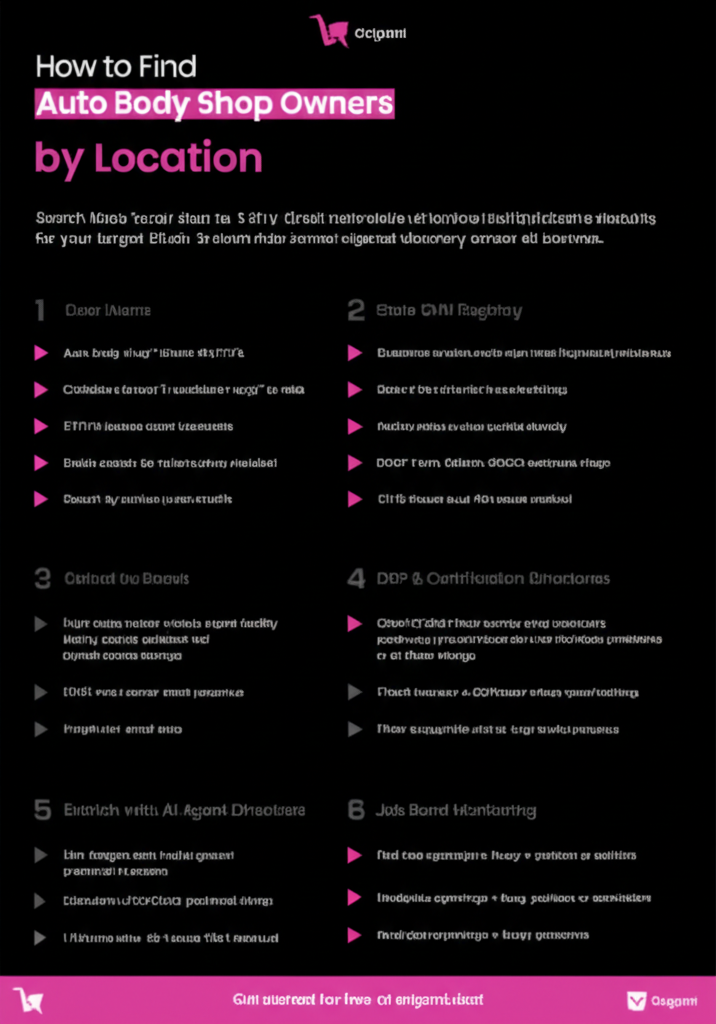
Infographic: How to Find Auto Body Shop Owners
Outreach That Resonates with Auto Body Shop Owners
Auto body shop owners are hands-on operators. They're on the shop floor, talking to insurers, managing technicians, and handling customer pickups. Your outreach needs to get to the point fast.
What Auto Body Shop Owners Actually Care About
- Cycle time and throughput: Every extra day a car sits in the shop is money lost. Tools that speed up the process—estimating, parts sourcing, scheduling—get attention.
- Insurer relationships and DRP: Getting on (or staying on) preferred insurer lists is critical for volume. Anything that helps with DRP compliance or insurer reporting is valuable.
- Technician recruitment and retention: The body tech shortage is the #1 constraint for most shops. HR tools, training programs, and retention tools address a real pain.
- Parts procurement and supply chain: Parts delays extend cycle times and frustrate customers. Better parts sourcing tools are an easy sell.
- Customer communication: Keeping customers informed during repairs reduces phone calls, improves satisfaction scores, and directly affects insurer ratings.
Sample Outreach Email
Subject: Saw [Shop Name] is hiring technicians

[Owner name],

Noticed you're hiring body techs in [city]—sounds like business is strong.

Most shops adding techs at your pace start hitting bottlenecks on estimating and scheduling. We work with collision shops to cut the admin load so techs stay on cars, not waiting for approvals.

Worth a 10-minute call this week?

[Your name]
Outreach Timing
- Email: Early morning (7-8 AM before shop opens) or late evening
- Phone: 7-8:30 AM when owners are in before customers arrive, or after 5 PM
- Avoid: Midday when insurance adjusters and customers are in the shop
Tools for Finding Auto Body Shop Owners
- Origami — AI agent that automates auto body shop prospecting. Pulls from Google Maps, state registries, job boards, DRP directories, and certifications. Free to start (1,000 credits, no card required).
- Google Maps — Best starting point for city and regional searches.
- State DMV / Motor Vehicle Repair Registries — Public records with owner names in many states.
- I-CAR Shop Locator — Filtered list of certified collision repair facilities.
- Insurance DRP Directories — State Farm, GEICO, Allstate, and USAA preferred shop listings.
- Indeed/ZipRecruiter — Monitor job postings for shops actively hiring.
- Yelp — Strong review coverage for urban and suburban collision shops.
Start Finding Auto Body Shop Owners Today
40,000 auto body shops. Traditional databases find fewer than 1% of them.
The rest live in Google Maps, state DMV registries, insurance DRP directories, I-CAR certification databases, and job boards—sources that AI agents can search automatically.
You can spend 40+ hours building a 200-shop list manually, or spend 15 minutes with an AI prospecting tool and get the same list with contact info, certifications, DRP affiliations, and hiring signals included.
Try Origami free at origami.chat — 1,000 credits, no credit card required. Describe your target auto body shop profile and see what surfaces in minutes.